
ISSUE 2 · WEDNESDAY, JUNE 3, 2026 · MINDSET
Stop Putting Your Happiness on Hold
The highest-yielding asset you're not actively managing.
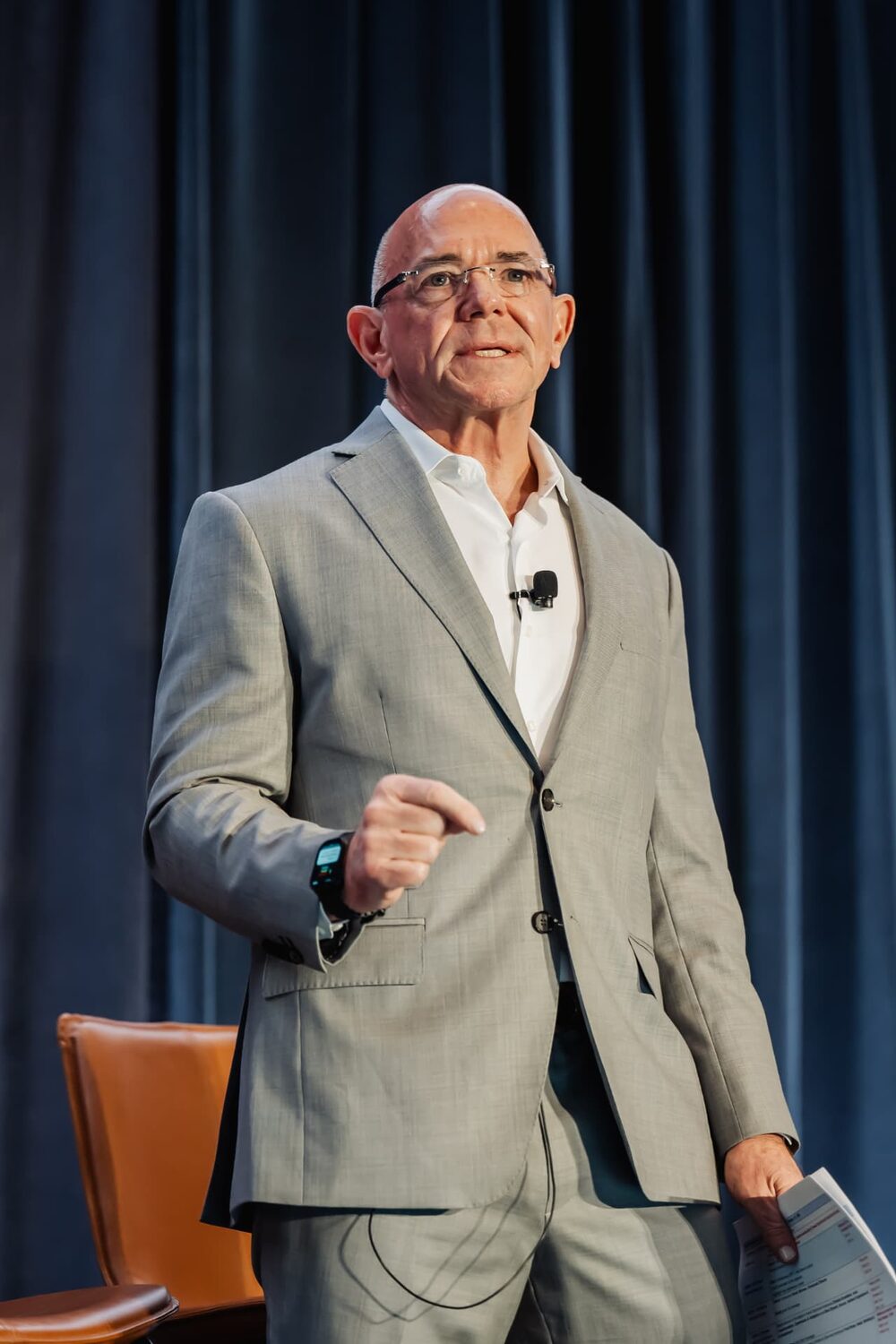
Darryl Traweek6 min read
What you focus on compounds.
That's not motivational fluff. It's the same principle that built every portfolio I ever managed across 40+ years in financial services. Compounding works in both directions — the asset you feed grows, the one you neglect shrinks. And the asset most operators never actively manage, the one with the highest return potential in their entire business, is their own mindset.
I want to talk about that today. Specifically, I want to talk about the mistake I see ambitious founders, advisors, and executives make over and over: they put their happiness, their confidence, their sense of momentum on hold until some future condition gets met. Until the deal closes. Until the hire lands. Until the launch hits. Until the market cooperates.
The longer you live by that math, the more you forfeit the only edge that's compounding in real time.
What You Focus On Gets Bigger
Try this. Right now, count three things working in your business. The clients who pay on time. The team member who quietly held a project together last week. The fact that you have demand at all. The decade of pattern recognition you carry into every meeting.
Now count three things that are wrong. The proposal that didn't close. The hire that didn't work out. The competitor that just announced something. The expense line that crept up.
Which list took less effort to populate?
If you're honest, the second list came faster. Almost involuntarily. That's not a character flaw — it's how the brain is wired. Threats compound faster than blessings unless you actively counter-program. The operators who don't counter-program live in a permanent state of "almost happy." Almost there. Almost ready. Almost satisfied. They earn more and enjoy less.
That's a terrible return on a life.
The "I'll Be Happy When…" Trap
I've coached over 800 advisors. I've sat across from hundreds of leaders during M&A integrations, in down quarters, in big launches. There's one phrase that signals — every single time — a person who's going to underperform their potential:
"I'll be happy when…"
I'll be happy when I hit $1M.
I'll be happy when I get the promotion.
I'll be happy when the deal funds.
I'll be happy when my team finally gets it.
Here's what's actually happening when you live that way. You're conditioning your nervous system to associate success with relief instead of joy. So when you hit the goal, you don't feel what you thought you'd feel. You feel a brief exhale, and your brain immediately scans for the next condition. The goalpost moves. You move with it.
And along the way, you miss everything. The build. The team forming. The unglamorous Tuesday afternoons that were, in hindsight, the best years of the business.
I lived this for a long time. I used to dread the weekly cycle of writing keynotes the way some people dread Mondays. Six days a week I'd think, here we go again, this is going to be hard. I had conditioned myself to expect difficulty, and work I genuinely love started feeling heavy.
The fix wasn't strategy. It wasn't a new process. It was a decision. I stopped waiting for the work to become easier and started enjoying that I get to do it at all.
Output improved the same week.
The Waiting Season Is the Work
Most operators I work with are in some kind of waiting season right now. Waiting for a market to turn. Waiting for a hire to ramp. Waiting for a partnership to formalize. Waiting for a launch to land.
The mistake is treating the waiting season as the not-real part of your career — the part you grind through to get to the real part.
The waiting season is the real part.
It's the longest stretch of your career. It's where character is built and capacity is forged. It's where the people who eventually win quietly install the systems, sharpen their skills, deepen their networks, and become the version of themselves the next chapter requires.
If you can't be content here, you won't be content there either. The math doesn't change just because the address does.
I tell every founder I work with the same thing: do everything you can, then leave it alone. Don't relitigate the proposal you already sent. Don't refresh the inbox for the fortieth time. Don't simulate the outcome in your head all weekend. You did the work. Trust the work. Go enjoy your Sunday.
That isn't passivity. That's discipline. The discipline to stop letting outcomes you can't control set the temperature of your daily experience.
Difficult Assignments Require Capacity, Not Avoidance
I've watched this pattern play out a hundred times in M&A integrations. The deal closes. Everyone celebrates. Then, almost immediately, the assignment gets harder than anyone modeled on the spreadsheet. Key people leave. Systems don't integrate cleanly. Culture takes twice as long to align. Synergies that looked obvious in due diligence look distant in practice.
The leaders who make it through aren't the ones who got the cleanest deals. They're the ones who carried the messy ones with their composure intact.
Difficult assignments don't come with the option of perfect conditions. They come with the option of how you carry them. The leaders I've watched build something durable — in financial services, in the trades, in tech — were never the ones with the smoothest path. They were the ones who had the internal capacity to keep moving through messy conditions without losing themselves in the process.
Capacity isn't built when things are smooth. It's built right here, in the friction, in the assignment you didn't pick, with the team you've got, in the market you're in.
The leaders who try to wait out the friction never build the capacity. So when the next, bigger assignment comes, they don't have what it requires.
The Mindset Shift, In Practice
If any of this is landing, here's what I want you to actually do this week. Not someday. This week.
One. Write down three things in your business that are working right now. Real ones. Specific ones. Not "I'm grateful for my team" — which person, which moment, which contribution. Specificity is the unlock. Vague gratitude is just performance.
Two. Identify the one "I'll be happy when…" sentence running in your head right now. The one quietly setting the ceiling on your daily experience. Name it. Write it down. Then ask yourself, honestly: when I get there, what makes me think the next "when" won't take its place?
Three. Pick one task this week that you currently dread, and make a decision — not a feeling, a decision — that you're going to enjoy doing it. Not because it becomes easier. Because you stopped fighting it. Watch what happens to the output.
These aren't soft exercises. They're balance-sheet items. The operator who runs their internal economy with discipline outperforms the operator who only runs their external one. Every time.
The OnlyUp Frame
The reason I built OnlyUp AI, the reason I wrote the book, the reason I started this newsletter — all of it traces back to one conviction:
Belief is limitless.
What that means, practically, is that the constraints you experience in your business are almost never about the market, the competition, the timing, or the team. They're about the ceiling you've installed on your own belief about what's possible from here. That ceiling is built, brick by brick, by every "I'll be happy when…" sentence you let run unchallenged.
The good news — and this is the part most operators miss — is that the ceiling is yours. You built it. You can take it down.
I've spent four decades watching people in financial services build extraordinary lives from ordinary starting points. The variable was never IQ. It wasn't connections. It wasn't even discipline, though discipline matters. The variable was their relationship with the present moment. Whether they enjoyed the build or merely endured it. Whether they trusted the compounding or fought it.
The ones who enjoyed the build went further. Every time.
So this week, wherever you are — closing a round, hiring a key seat, repairing a difficult relationship, recovering from a setback, waiting for something to break your way — consider this: the version of you who is content right now is the same version that's going to handle the next chapter without flinching.
Be content here. Build capacity here. Enjoy the assignment here.
Then watch what's waiting for you on the other side of it.
Belief is Limitless. OnlyUp.
— Darryl
Belief is limitless. OnlyUp.
— Darryl